
The case for principles-based corporate governance
The case for principles-based corporate governance
1 September, 2026 •Corporate governance in financial services remains overly rules-based. In many markets, corporate governance frameworks prioritise tick-box compliance with prescribed requirements over the quality of oversight, decision-making, responsibility and accountability for performance and risk.
As financial systems evolve in line with digital innovation, new business models and increasingly complex risk profiles, this compliance-driven approach is becoming misaligned with reality. Regulators themselves increasingly recognise that volatility and systemic risk are rising, yet regulatory design continues to reward procedural adherence rather than informed judgement. The result is governance approaches that meet formal standards but often fall short of genuinely embracing the interests of stakeholders or strengthening institutional resilience.
What is corporate governance and why the regulatory approach matters
Corporate governance gained global prominence in the late 20th century in response to the growing separation of ownership and control in large corporations (Ma and Shleifer, 2025). Traditionally, its primary purpose was to ensure that managers acted in the interests of shareholders by strengthening oversight, accountability and financial discipline. In this sense, governance frameworks were largely designed to protect investor value and mitigate agency problems between owners and executives, in particular, the risk that executives may make decisions that serve their own interests rather than those of shareholders.
In the financial sector, the shareholder-centric model has increasingly been called into question. Financial institutions not only intermediate capital on behalf of owners; they also hold consumer deposits, allocate credit across the economy and transmit risk across interconnected systems. As a result, failures in governance approaches have consequences that extend far beyond shareholders.
This has driven a gradual shift in how governance is understood. It has moved from a narrow focus on shareholder protection towards a broader concept that includes outcomes such as adequate consumer protection, ethical conduct, sound risk management and systemic stability.
In principle, strong governance in financial institutions supports long-term value creation while also safeguarding consumers, mitigating misconduct and ensuring boards actively oversee performance and risk. Governance is not simply about maximising returns; it is increasingly about balancing profitability with resilience, trust and public interest outcomes.
How governance is regulated in practice plays a decisive role in whether this broader purpose is realised
As visualised below, regulators typically adopt governance frameworks that sit between purely rules-based and fully principles-led approaches. Any framework that moves beyond strict prescription will, to varying degrees, with support from a principles-based approach. Risk-based approaches may be framed in a rules or principles manner. In practice, this means that governance frameworks exist on a spectrum, with some jurisdictions placing greater emphasis on outcomes and judgement than others.
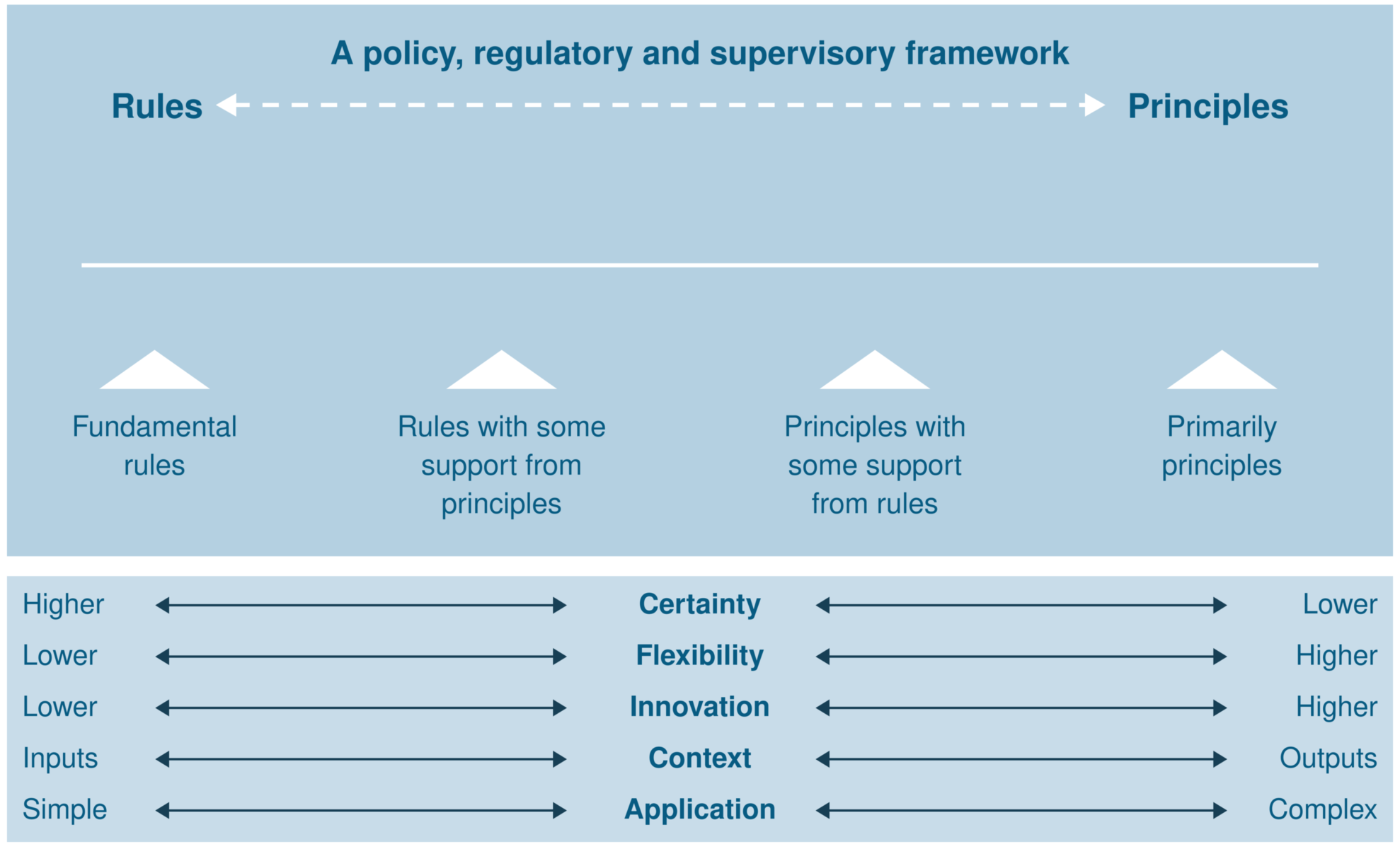
Source: Compliance and risk resources
As regulatory frameworks shift from prescriptive rules to outcome-oriented principles, they trade certainty for flexibility and innovation. Rules-based regulation, with its detailed requirements, offers clarity and uniformity, supporting consistency in early-stage markets or sectors where predictable application is critical (George, 2024). Yet, it can stifle innovation, limit adaptability, and quickly become outdated in rapidly evolving environments.
Principles-led regulation, by contrast, sets broad standards tied to desired outcomes, such as fairness, accountability, transparency, and sound risk management, allowing institutions to exercise contextual judgement in achieving them (George, 2024). This approach shifts responsibility from regulators as procedural enforcers to governing bodies as true stewards. They must navigate complexity and tailor compliance to their business models and risk profiles, fostering both innovation and more dynamic governance.
The reality is that many financial institutions remain constrained by compliance-heavy, rules-based cultures. Boards often focus on meeting formal requirements rather than evaluating outcomes in context, shaping decisions around procedural adherence rather than the quality of oversight or long-term resilience.
A rules-based approach often specifies in detail how governance should work, for example, the exact number of committee members, their qualifications, how often they must meet and which items must appear on the agenda. While this can improve consistency and make supervision easier, it can also encourage a tick-box approach.
A board may meet every procedural requirement yet still fail to meaningfully consider stakeholder interests. In other words, compliance with the rules does not necessarily mean good governance in practice. The focus should be on achieving sound, sustainable and stakeholder-conscious decision-making, rather than prescribing exactly how it must be achieved.
Transitioning towards a principles-led approach is therefore critical
Boards that embrace judgement, accountability, and ethical leadership are better positioned to manage complex risks, make informed strategic decisions, and safeguard stakeholders. Principles-based governance provides the mechanisms for this transition, ensuring that rules serve as a foundation while culture, risk awareness, and decision quality become central to oversight. Box 1 provides a practical example:
Box 1:
South Africa’s King V Code emphasises ethical leadership, stakeholder inclusivity, and integrated thinking, guiding boards to embed accountability and values into decision-making rather than simply enforcing compliance (Institute of Directors South Africa, 2025).
It leverages an “apply and explain” model, which requires an organisation to implement the core principles of a governance code and provide a narrative explanation detailing exactly how it did so. To complement this principle with guidance, it also provides recommended practices instead of mandatory practices. This forces the board to move away from a tick-box approach and deeply consider and articulate how governance practices actually deliver value and positive outcomes for the business.
The distinction between the principles-based approach adopted in King V and a rules-based approach becomes clearer when applied to a practical governance issue. Consider a financial institution that is considering awarding a major technology contract to a company partly owned by the CEO’s spouse.
Under a rules-based approach, the framework might prescribe a set of specific requirements for managing the conflict, such as:
- the conflicted director must disclose the interest
- the conflicted director must recuse themselves from the decision
- the transaction must be approved by independent directors or the relevant committee, and
- the decision must be documented and disclosed.
The board’s primary question therefore becomes:
“Have we followed the prescribed process for managing this conflict?”
If the CEO discloses the interest, recuses themselves, the independent directors approve the transaction and the decision is properly documented, the board may have satisfied the applicable requirements.
A principles-based approach, such as that reflected in King V, starts from a different question. King V expects the governing body to lead ethically and effectively and recommends that members of the governing body cultivate and demonstrate integrity, including avoiding conflicts of interest where possible and, where they cannot reasonably be avoided, disclosing and managing them diligently in accordance with their legal and fiduciary duties.
The question is therefore not simply whether the prescribed steps have been followed, but whether the conflict has been managed in a way that supports objective, ethical and accountable decision-making and protects the organisation’s interests.
The board might consequently ask:
“Can we demonstrate that this decision was made objectively, that the organisation has received fair value, and that the conflict has been managed in a way that maintains confidence in the decision?”
This may lead the board to tailor its response to the circumstances. For example, it could:
- require a competitive procurement process or independent assessment of value for money
- require additional scrutiny from an independent board committee, or
- conclude that, given the nature and materiality of the relationship, the transaction should not proceed at all.
The important distinction is therefore not that a principles-based board necessarily does more than a rules-based board. Rather, it requires the board to exercise judgement about whether the governance objective has actually been achieved and to be able to explain and defend its approach.
The key difference:
- Rules-based: “Have we followed the prescribed requirements for managing the conflict?”
- Principles-based: “Have we exercised appropriate judgement to ensure the conflict is managed effectively and that the resulting decision is ethical, objective and in the organisation’s best interests?”
In this sense, a rules-based framework provides greater certainty about the process to be followed, while a principles-based framework provides greater flexibility but places greater responsibility on the governing body to exercise judgement, consider the circumstances and demonstrate why its approach achieves the intended governance outcome.
From rules to principles in a risk-based approach: not easy, but game-changing
Although principles-based regulation offers clear benefits, transitioning from rules-heavy frameworks is difficult in practice. Regulators must balance increased uncertainty and the risk of inconsistent application and enforcement when relying on judgement rather than prescriptive rules (Georgosouli, 2023). Supervisors need new tools and approaches to assess outcomes instead of tick-box-based compliance. Institutions, meanwhile, often struggle with the added discretion and responsibility, particularly when entrenched in compliance-driven cultures.
Despite these challenges, the shift is increasingly important. Rules alone struggle to keep pace with a rapidly changing world driven by new technologies and emerging risks. Principles, by contrast, provide a stable foundation that guides behaviour and promotes sound, risk-aware decision-making as markets evolve.
Regulators, supervisors and institutions should thus continue on a progressive journey towards becoming more risk- and principles-based. This includes taking on practical steps such as testing outcomes-based reporting, building capability through peer exchanges, and learning from markets where principles-based governance is already working (Hope, Gray, and Hougaard, 2025). The aim with such activities should be to generate buy-in for the transition among stakeholder groups, while designing systems that genuinely respond to financial-sector risk, uphold ethical conduct, and build long-term resilience. Starting this transition is a commitment to putting substance over form, and driving oversight that truly strengthens institutions.