
Layering risk and building resilience: rethinking municipal disaster insurance
Layering risk and building resilience: rethinking municipal disaster insurance
23 November, 2026 •South African municipalities are on the frontline when disasters strike. For example, in March 2025, severe flooding caused an estimated R1.4 billion in infrastructure damage in eThekwini, while storms in June of 2026 left George municipality facing an estimated R250 million infrastructure bill. For many municipalities already operating under significant financial and structural constraints, such unexpected costs can place considerable pressure on budgets and their ability to maintain essential services.
Our previous blog on municipal disaster risk financing highlighted a familiar pattern: municipalities remain heavily reliant on the disaster grant system from National Treasury when disasters strike, while insurance is often underused or poorly aligned with the risks they face.
When adequate disaster financing is unavailable, municipalities may redirect funding from infrastructure maintenance, capital investment and other service-delivery priorities to finance urgent repairs. This approach may help address the immediate crisis, but it can also weaken resilience and leave municipalities more exposed when the next disaster occurs.
The challenge is not simply that municipalities need more money. Without a clear understanding of the potential costs of disasters, it is difficult to determine how much financing is needed or how best to prepare for those costs. Municipalities therefore need both a better understanding of their financial exposure and to identify the right mix of financing instruments suited to the different risks they face.
Municipalities may have insurance, but it is not always being used as part of a broader strategic approach to managing and financing risk
Cenfri’s 2025 study with the World Bank found that only around one-third of the municipalities interviewed had used insurance following a disaster. Municipalities pointed to high premiums and excesses, exclusions of key infrastructure, gaps in available products and slow claims processes as some of the barriers.
The study also found that municipalities do not always have a clear understanding of how insurance should fit into their broader approach to managing disaster risk. Insurance can often be treated as a standalone procurement exercise, with difficult claims or disappointing payouts reinforcing perceptions of poor value for money.
However, this perception often reflects broader capacity and information constraints. Municipalities may be uncertain about what is covered, what evidence is needed when making a claim, or how losses need to be demonstrated. Weak information on hazard exposure, assets and historical losses make it harder to estimate the financial cost of disasters. Without this understanding, municipalities struggle to determine how much risk they can afford to retain, how much insurance they need and whether the cover they purchase provides value for money.
The question is therefore not simply: does the municipality have enough insurance? Instead, we should be asking: which risks should the municipality reduce, retain, and transfer, and which financing tools are best suited to each type of risk?
A practical guide to using insurance to strategically manage risk
Cenfri supported the development of a Good Practice Guide published by the Cities Support Programme (CSP) in partnership with the World Bank and State Secretariat of Economic Affairs (SECO), to help municipalities make more informed decisions about how to use insurance as part of their disaster-risk-financing strategies.
The guide emphasises the starting point: municipalities first need to understand which assets and services are at risk, how frequently disasters are likely to occur and what potential financial losses could be. This provides a basis for assessing which risks can be reduced or prevented, which costs municipalities can absorb themselves, and which risks need to be transferred through insurance or other financing instruments.
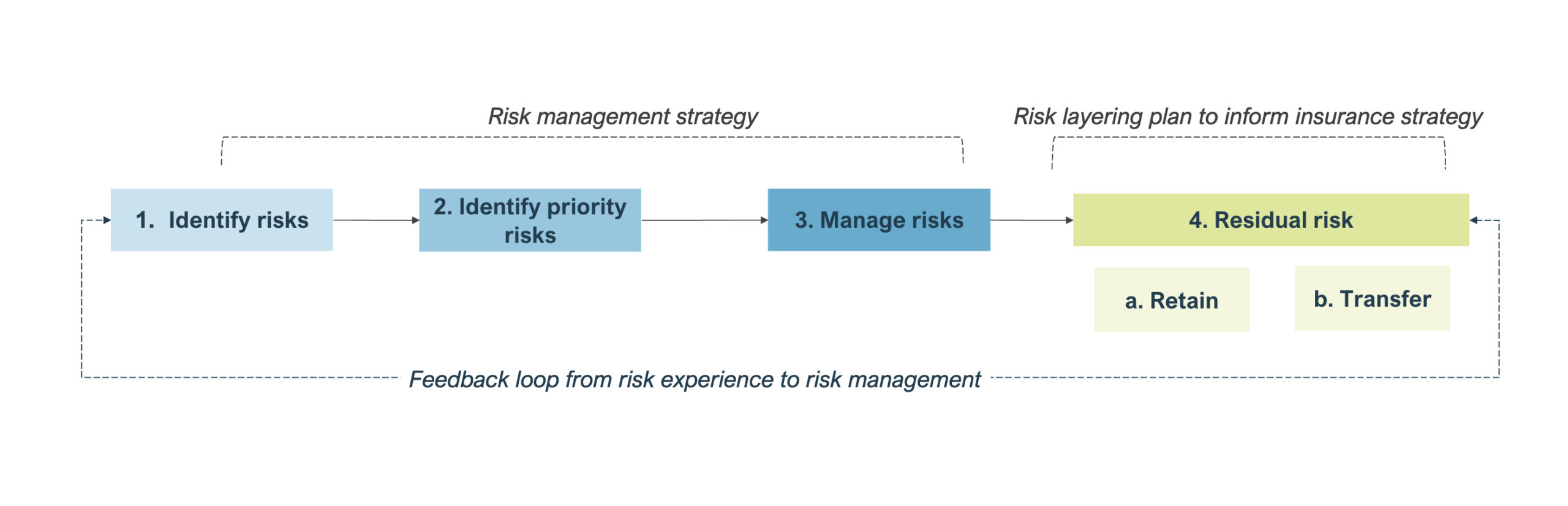
Figure 1:
From risk management to risk transfer
Source: Cities Support Programme & World Bank (2026)
Deciding which risks municipalities should retain or transfer
There is no single financing instrument that works for every disaster. Different tools have different strengths and weaknesses, and municipalities need to weigh several practical considerations when deciding how to finance a particular risk.
Five considerations are especially important:
- Nature of the hazard: The frequency and severity of a hazard help determine whether a municipality is better placed to absorb the loss itself or transfer it elsewhere.
- Limit: Each instrument is subject to inherent limits that affect how much funding it can provide and how reliably it will respond to losses.
- Cost: Instruments involve different trade-offs between paying upfront and financing losses after a disaster, while costs also vary relative to expected payouts.
- Timing: Some instruments provide funds faster than others, which matters because financing needs differ across response and recovery.
- Availability: Access to particular instruments may depend on market conditions, institutional arrangements and municipal capacity.
Together, these considerations can help municipalities build a risk-layering approach – the practice of combining different financing tools to address different categories of disaster risk, rather than relying on a single financing mechanism.
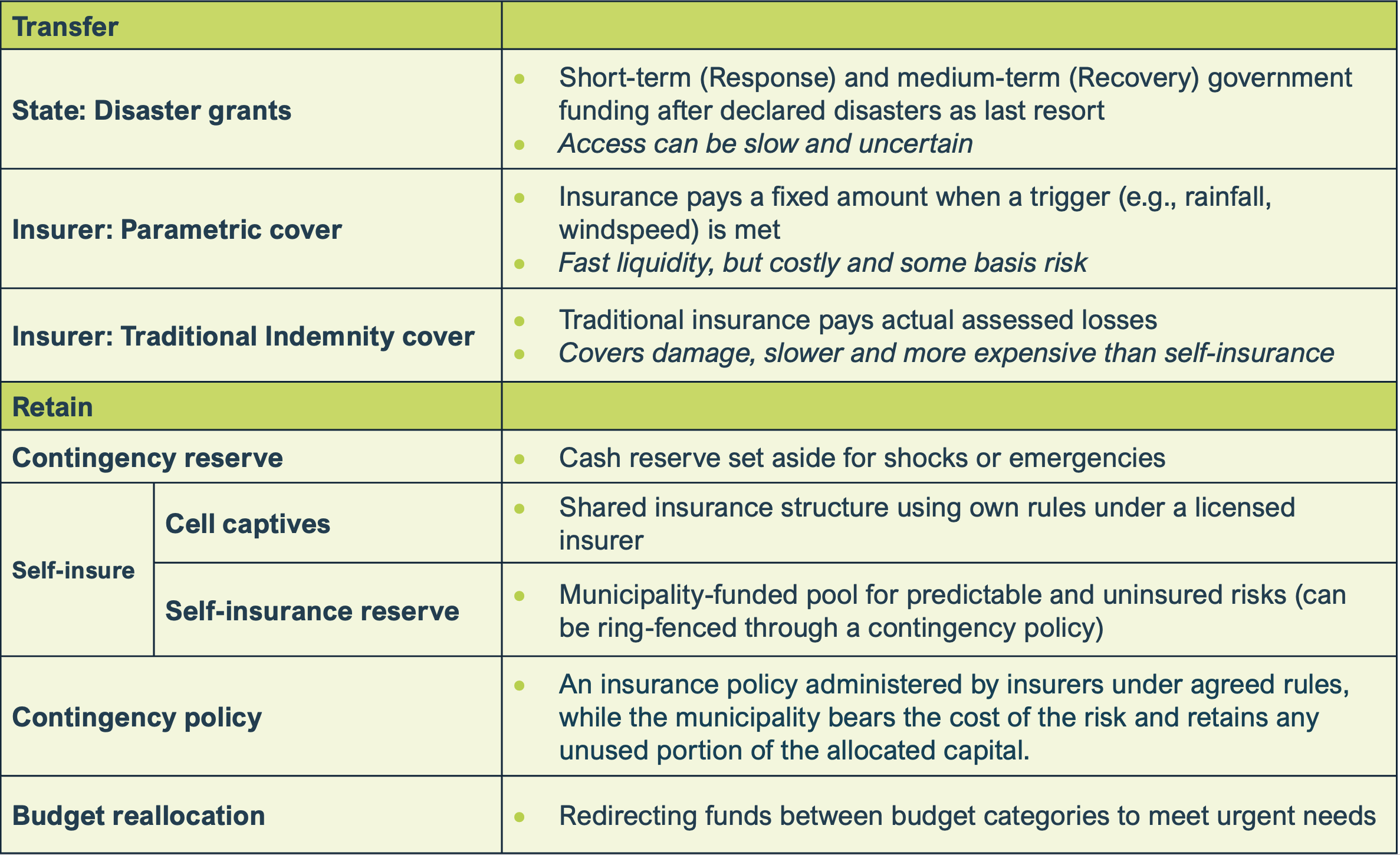
Figure 2:
Risk-layering model that integrates insurance into existing municipal financing tools*
Source: Cities Support Programme & World Bank (2026)
*This model does not include debt instruments as the focus of the guide was on how to integrate insurance into disaster-risk-finance strategies.
Once municipalities have identified the risks they want to transfer, specialist advice – such as from a knowledgeable and experienced broker – can help translate that strategy into appropriate insurance specifications and procurement requirements.
Each layer comes with trade-offs
Each layer of risk financing comes with its own costs, benefits and limitations. Risk layering does not eliminate these trade-offs but helps municipalities weigh them against the types of risk they face and make more deliberate financing decisions in advance.
For example, traditional insurance protects municipal finances against large and unexpected losses and provides funding for recovery. However, municipalities must pay premiums and excesses and comply with policy requirements. Exclusions may also leave important assets uncovered, while complex claims can take time to assess.
On the other hand, parametric insurance provides quick access to funds and provides flexibility in what the payout is used for. However, it also comes at a large premium cost, and the potential for basis risk. This means that the trigger may be reached without losses matching the payout, or serious losses may occur without the trigger being reached. It also requires a clear disbursement plan in advance to ensure proper use. At national level, Jamaica’s catastrophe bond provides one example of this type of trigger-based catastrophe financing, designed to provide rapid funding when predefined disaster conditions are met.
The objective is to balance these trade-offs by combining instruments that complement one another and respond to different risks and financing needs.
However, these financing decisions are only as good as the information underpinning them. Municipalities need to understand their financial exposure to disasters, including which assets are at risk and the potential costs of damage. This requires reliable information on asset location, condition, maintenance history and replacement values, alongside historical disaster losses and insurance claims. Such information helps municipalities estimate their financing needs, determine which risks to retain or transfer, and secure appropriate cover that reflects their actual exposure.
Building resilience starts before disaster strikes
Building municipal resilience starts with understanding the potential costs of disasters and deciding in advance which risks to reduce, retain and transfer, and how best to finance them.
The Good Practice Guide provides a practical framework to help municipalities make these decisions, select an appropriate mix of financing instruments and procure insurance more strategically.
South African municipalities are already exploring more innovative approaches to risk layering, with two metros considering parametric insurance options, and Mossel Bay municipality implementing a contingency insurance policy as part of its DRF approach.
To read more about options and examples, click here to read the full guide.
Endnote:
The Good Practice Guide was developed in collaboration with the South African Insurance Association (SAIA), Financial Intermediaries Association (FIA), the Institute of Risk Management South Africa (IRMSA) and the South African Local Government Association (SALGA).