Why using public-sector data for policy is harder than it looks
Why using public-sector data for policy is harder than it looks
11 May, 2026 •Across Africa, as elsewhere in the world, governments are increasingly aware that data is essential for effective policymaking. Yet when ministries and agencies take the first steps toward using their data more systematically, they encounter a familiar set of technical and institutional challenges. These challenges are not unique to any one country, Cenfri’s work with different governments has highlighted similar issues, and they are echoed by findings from global studies.
This article reflects some of the issues governments encounter when they take the first steps in increasing the use of existing administrative data for policy and regulation – drawing on both global evidence and Cenfri’s direct engagement with public institutions.
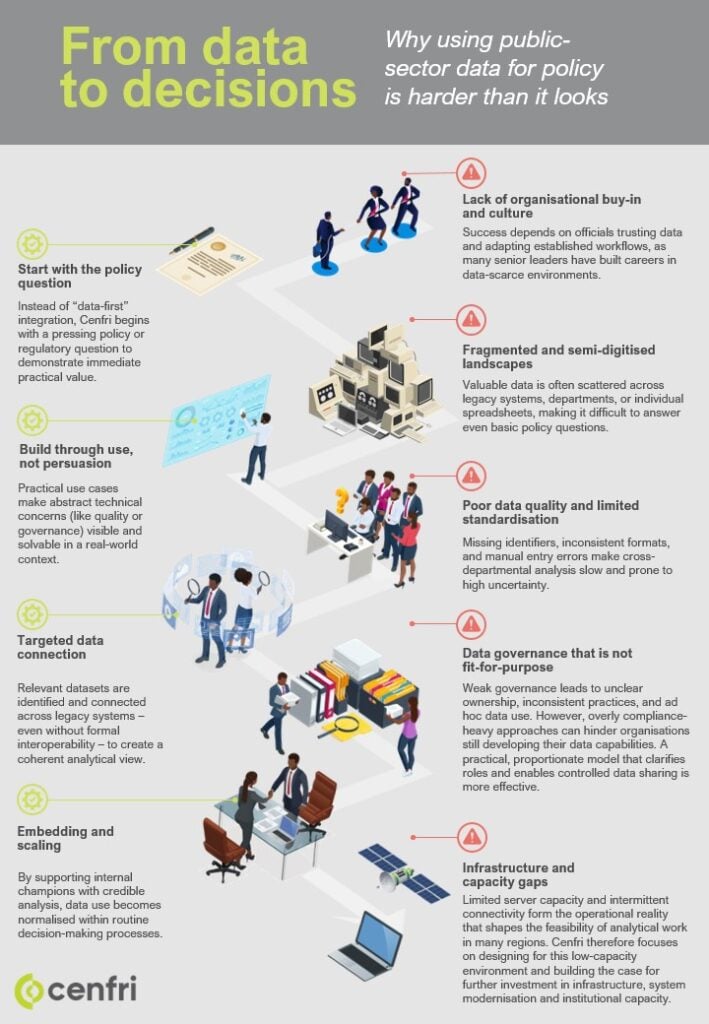
(See the infographic summarising some key takeaways at the end of this article).
1. Limited organisational buy-in, incentives and change management
A foundational challenge governments face in using data for decision-making is building organisational buy-in. While mandates to “use data” often come from senior leadership, their success depends on whether officials across the organisation understand the value of data, trust it, and are willing to adapt established ways of working.
International research consistently highlights organisational culture and incentives as key constraints to data-driven policymaking. OECD (2019) and World Bank (2022) studies note that many senior policymakers built their careers in data-scarce environments, where decisions relied more on experience, precedent and negotiation than on systematic evidence.
As a result, introducing data into policy processes represents a shift in decision-making norms, not just an improvement in technical capacity. This challenge is reinforced where institutional processes do not actively demand evidence at key decision points, or where data is not available in a timely or usable form.
Cenfri’s engagements with governments surface the same dynamics. In several contexts, enthusiasm for data use is driven by younger officials or technical staff, who must then convince more senior decision-makers of its relevance and reliability. In other cases, senior leadership is supportive, but momentum falters where incentives, workflows or frontline practices do not reinforce the use of data. A key success factor has been to build trust over time by delivering value, starting with initial key counterparts, but expanding more broadly in an organisation through repeated delivery. These experiences underscore that without sustained buy-in and change management across the organisation, investments in data systems alone are unlikely to translate into routine, evidence-based decision-making.
In practice, Cenfri’s engagements suggest that organisational buy-in and trust is most effectively built through demonstration rather than persuasion. We start by working with partners to develop concrete use cases that clarify how existing data can inform real policy or regulatory decisions, demonstrating the data’s practical value. In other words, the value of data is best demonstrated when the starting point is a key policy question – a policy first approach, as opposed to a data first approach. By working with officials on current policy questions, then supporting internal champions with credible analysis, and thereafter embedding data into routine decision processes, Cenfri’s work helps build trust and normalise data use without relying on formal change-management interventions.
2. Fragmented and unevenly digitised data landscapes
In most governments, valuable data is scattered across departments, agencies and legacy systems. The World Bank (2022) highlights fragmentation and poor interoperability as common constraints in low- and middle-income countries. These challenges are often compounded by uneven digitisation, where public sector entities operate a mix of paper-based records, spreadsheets and digital systems. As a result, datasets are incomplete, inconsistent or difficult to reconcile, making it hard to answer even basic policy questions without stitching together multiple sources.
Cenfri’s engagements with policymakers surface the same realities. Partners frequently contend with parallel systems within the same ministry, semi-digitised workflows, and critical datasets maintained in individual spreadsheets with no central visibility. This combination of fragmented systems and partial digitisation creates significant practical barriers to routine data use, even where substantial amounts of information are already being collected.
In practice, Cenfri’s engagements show that fragmented data landscapes are best addressed in the context of specific use cases, rather than upfront/whole system integration. By starting from a specific policy question, Cenfri works with officials to identify and connect relevant datasets across legacy systems (and even across ministries and agencies where necessary), even where no formal interoperability exists. Through targeted analysis and shared outputs such as dashboards, fragmented administrative data, even where it is limited, is brought into a coherent analytical view, helping reduce reliance on manual spreadsheets and individual knowledge while making data gaps and constraints explicit.
3. Poor data quality and limited standardisation
UN Global Pulse (2018) emphasise data quality as a universal bottleneck for evidence-based decision-making. Similarly, OECD (2019) shows that without common formats, taxonomies and documentation, governments struggle to combine data into meaningful insights. Many ministries still capture the same variables in different formats or maintain no metadata describing how data was collected. Missing identifiers, inconsistent date formats, duplicate entries or manually entered numbers that do not add up are widespread issues.
This makes cross-department analysis slow, uncertain and error-prone—exactly what Cenfri observes when engaging with partners as they try to prepare data for policy questions: datasets with impossible dates, inconsistent ID numbers or crucial fields left blank because frontline staff do not see the value of capturing them accurately.
In practice: Cenfri’s engagements also show that poor data quality and limited standardisation are best addressed by using practical use-cases as the departure point, rather than cross-cutting institutional compliance. This approach allows data quality issues such as missing identifiers, inconsistent formats or implausible values to become visible in practice, rather than remaining abstract technical concerns. Cenfri supports partners in aligning variables and formats only where needed for specific analyses, documenting assumptions and limitations, and feeding insights back to data producers so that the link between data capture and decision-making is clearer. This incremental, use-case-driven approach helps improve data quality as the work progresses, without relying on comprehensive standardisation or enforcement upfront – which could take a long time to implement.
4. Fit-for-purpose data governance as a foundational need
International studies frame data governance as an important enabler of routine, trustworthy data use in the public sector. The OECD (2019), for example, emphasises that governments need clear governance arrangements – such as defined roles, responsibilities and rules for managing and using data – if data is to be integrated into decision-making at scale. Similarly, UN System (2023) work on comparing data governance frameworks highlights the importance of clear responsibilities, alongside procedures that enable the safe sharing, use and reuse of data across stakeholders.
In practice, many of the data challenges policymakers experience – including poor data quality, fragmented data landscapes, unclear ownership of datasets, and ad hoc arrangements for accessing and sharing data – stem at least in part from a lack of data governance. Where roles are not defined, documentation is inconsistent, and no clear processes exist for managing or sharing data, even motivated teams tend to rely on individual knowledge, informal relationships and workarounds rather than durable institutional practice.
At the same time, Cenfri’s experience suggests that the challenge is not only the absence of data governance, but also the risk that the first governance approaches adopted are not fit for purpose. In early-stage environments, data governance can easily become overly compliance-focused, process-heavy and centred primarily on data protection rather than data use. This often results in governance models that are difficult to implement, poorly matched to institutional capacity, and of limited practical value to organisations that are only beginning to use data more systematically.
Working with partners, Cenfri’s data governance work therefore aims not simply to introduce formal structures, but to support proportional and practical governance that fits institutional realities. In practice, this means linking governance to specific use cases, focusing on enabling managed data sharing, and supporting practical routines that make data more usable and reusable across teams and institutions. This requires clarifying objectives, identifying responsible roles, improving the consistency of documentation and definitions, and putting in place lightweight processes that support trusted and governed data use (Also see Cenfri, 2024). The emphasis is on enabling the managed utilisation and sharing of data to deliver value to the organisation, rather than on compliance and protection alone.
In addition, through Cenfri’s RED programme, we’ve also assisted on the development of a National Data Sharing Policy (Cenfri, 2025) a framework designed to enable secure and governed exchange of data across government institutions.
5. Gaps in infrastructure and connectivity as a constraint
Reliable digital infrastructure – including connectivity, server capacity and hardware – is widely recognised as a foundational enabler of digital government and data-driven policymaking; without it, even digitised systems struggle to support routine data access, sharing and use across agencies. International assessments emphasise that digital public infrastructure underpins effective cross-government systems, inclusive service delivery and interoperable data exchanges, and that gaps in connectivity and infrastructure remain a key constraint for many governments. (For example, see OECD, 2024)
Cenfri’s engagements with policymakers encounter these infrastructure constraints as background conditions that shape what is feasible in practice. Limited system performance, intermittent connectivity or restricted access to central servers can affect the scope, frequency and sophistication of analytical work. While these issues are not the primary focus of Cenfri’s engagements, they form part of the operational reality within which data is collected, accessed and analysed.
Addressing infrastructure gaps typically requires long-term investment, coordination and financing, and governments often work with development partners and donors specifically focused on digital infrastructure, connectivity and system modernisation. Cenfri’s role in this context is complementary: we design for low-capacity environments, working with existing data and systems as they are. By focusing on practical use cases that deliver value under current constraints, Cenfri helps demonstrate the value of stronger digital and analytical capacity – thereby helping build the case for further investment in infrastructure, systems and institutional capability.
Cenfri’s work
Taken together, these constraints explain why so much potentially valuable public-sector data remains under-used. They also define the context in which Cenfri works with governments: we engage with governments and regulators at the point where they recognise these bottlenecks and need practical support to turn existing data into reliable inputs for policy and regulation.
Cenfri’s engagements often begin at moments of opportunity — when policymakers are grappling with pressing policy questions or constraints and are open to rethinking how existing data can be used. By working on relevant and priority issues, Cenfri helps demonstrate the practical value of data in decision-making, building confidence and interest that can catalyse further investment in data systems and capabilities. This practical demonstration also builds trust and generates additional demand from other government entities – which then allows the process to repeat.
Cenfri has been working with the Mastercard Foundation, The Hewlett Foundation, UNCDF and GIZ to support governments in their journey to unlocking data for better decision making and improved digital service delivery.
Building on in-depth work done in Rwanda since 2021, and in Tanzania since 2025, we are engaging with stakeholders in a broader set of countries including Ethiopia, South Africa, Ghana and Uganda.
In Rwanda alone, Cenfri has worked with 96 administrative datasets across 34 public and private sector institutions — supporting not only analysis, but also the development of data pipelines, analytical tools and institutional capacity, influencing 19 policy areas, and implementing 17 analytical dashboards for 7 different partners across different sectors, including telecoms, education, the financial sector, agriculture and others. This progression has enabled Cenfri to engage on more system-level challenges, including sectoral data interoperability and data exchange, which is the primary entry point for our work in Tanzania.
Through this work, Cenfri helps governments move from fragmented, under-used datasets to institutionalised, routine data use — supporting better decisions and service delivery that ultimately improve people’s lives.