
How governments can decide which AI opportunities to pursue: A decision framework for emerging economies
How governments can decide which AI opportunities to pursue: A decision framework for emerging economies
29 October, 2026 •Public-sector decision makers face a growing stream of AI proposals, each promising smarter services, stronger institutions or faster results. The first question is usually whether a proposed AI use case can solve the problem at hand. Often, the answer is simple: yes, it can.
But that does not mean it can, or should, be implemented. The harder question is whether it is worth pursuing, which implementation choices are realistic, whether public resources will deliver true value, and whether risks or feasibility constraints could undermine the effort.
In a previous article, Cenfri focused on the considerations around AI implementation pathways. We now shift focus from how to implement AI, to considerations around value, feasibility and risks. In other words, will this AI deployment save money, improve lives, or strengthen the economy? And can those benefits be achieved without exposing institutions (or the whole of government) to new risks or overcommitting scarce resources?
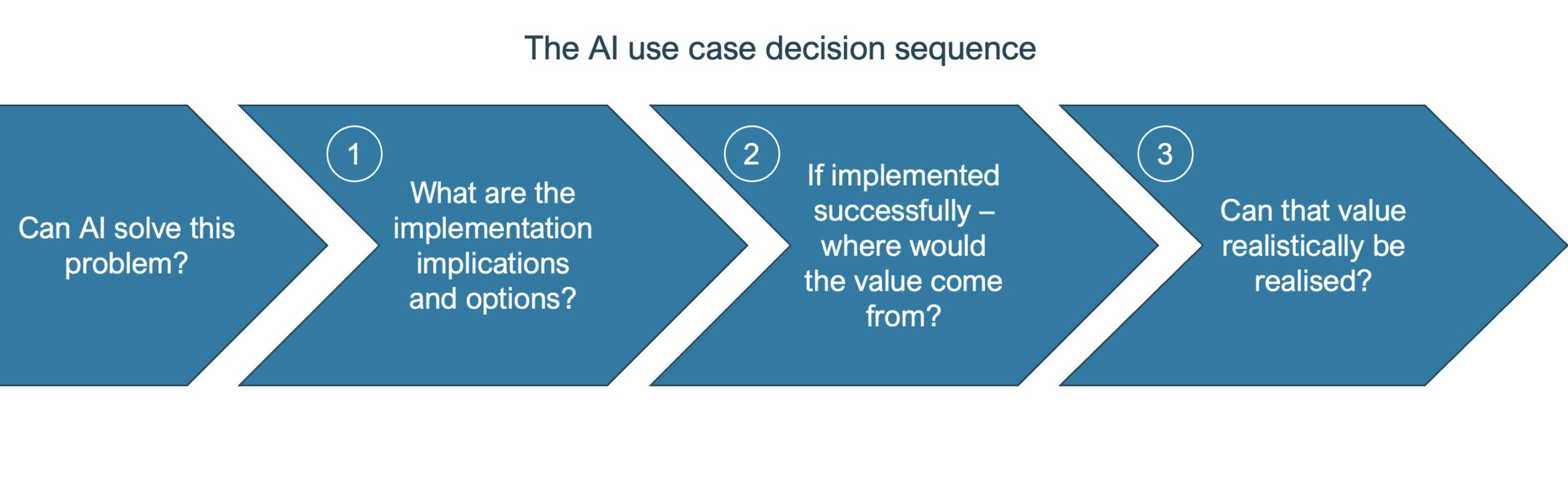 Not every AI opportunity is worth implementing. Some may be quick wins with low cost and manageable risk. Others may promise transformational value but require significant investment, institutional reform, or long-term capability building, or create dependencies on external technology providers that limit future flexibility and national agency.
Decision makers therefore need to understand what value a use case can create, and whether that value can be realised in practice. These two questions are especially important for emerging economies, where public resources, technical capacity and implementation bandwidth are limited. Governments cannot pursue every AI opportunity at once. They need a way to distinguish between use cases that are attractive, feasible and valuable – and those that may be expensive distractions.
What kind of value could AI create?
At Cenfri, we distinguish between three broad types of value:
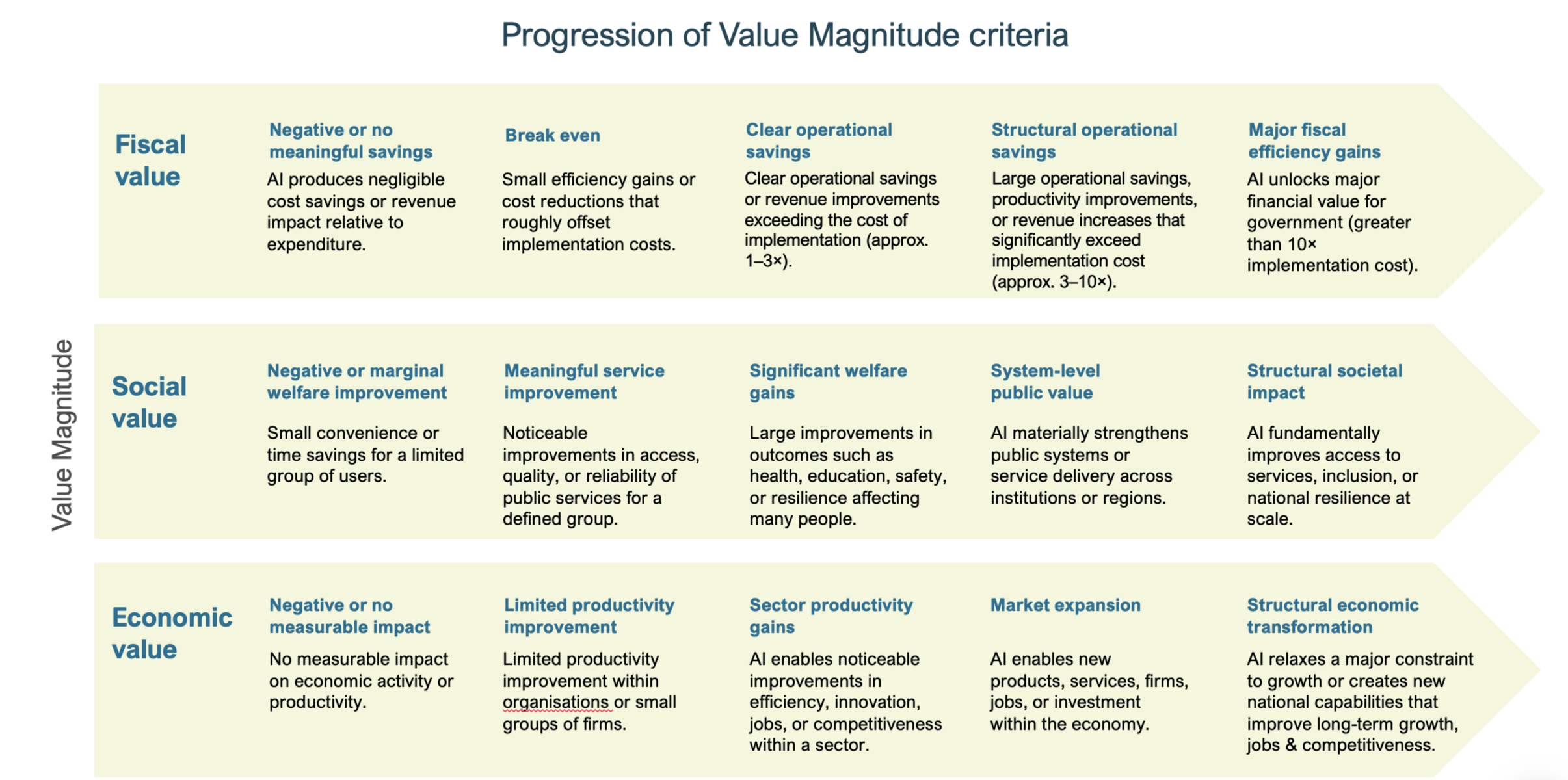
- Fiscal value: improvements in government efficiency and finances, such as cost savings, productivity gains, better spending effectiveness, reduced losses or improved revenue collection.
- Social value: improvements in public outcomes, such as better access to services, stronger inclusion, improved welfare outcomes, greater resilience and increased trust in government.
- Economic value: broader benefits to the economy, including productivity growth, innovation, competitiveness, job creation, market development and structural transformation.
Most AI use cases create a combination of these benefits. For example, an AI-assisted public service may improve operational efficiency for government (fiscal value) while simultaneously improving service quality and accessibility for citizens (social value). In other cases, AI may help unlock productivity gains across a sector, creating broader economic benefits alongside social outcomes. Our downloadable framework provides examples of the type of value that can be achieved in each category.
The scale of impact matters though. The key question is not simply whether an AI opportunity can create value, but how much value it is likely to create in practice. Some use cases may generate modest, localised improvements, while others have the potential to create system-wide fiscal savings, significant social impact or transformative economic benefits. Understanding both the type and magnitude of value is therefore a critical first step in prioritising AI opportunities. Our framework sets out this progression:
Some forms of value are easier to realise than others. Fiscal value often has the shortest pathway to impact: an AI tool changes an operation, which may translate relatively directly into savings, higher productivity or additional revenue. Social value usually has more steps between the technology and the outcome – a service must improve, people must use it, and that change must translate into better outcomes. Economic value can be even further removed, requiring adoption at scale, productivity gains and market responses before effects on growth or jobs emerge.
Each additional step creates another condition that must hold for the expected value to materialise. This does not make social or economic value less important – indeed, these may offer the greatest long-term returns. But it does mean that they generally take longer to realise, are harder to attribute to the AI intervention, and require greater care when estimating value upfront. Use cases that offer fiscal value, on the other hand, may provide clearer early learning opportunities because the value is more direct, measurable and near-term.
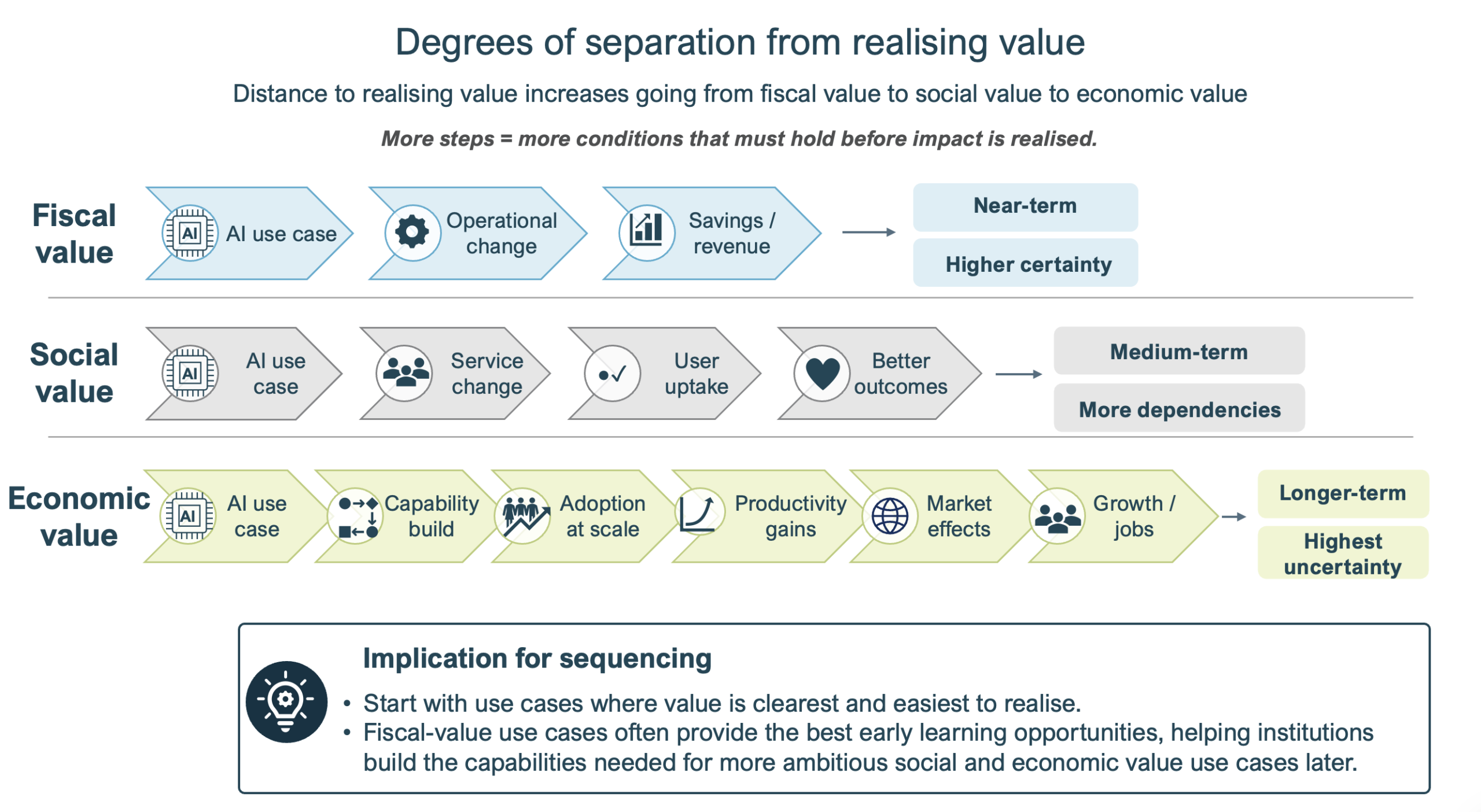
Governments need to consider the trade-offs between immediacy and ambition. Some of the most important AI opportunities may not generate immediate savings, but may help overcome binding constraints to development, productivity or service delivery. For instance, a local-language model may not deliver short-term fiscal returns. However, it could create wider social and economic value by reducing linguistic and digital access barriers and helping citizens access services in local languages / their native tongue.
Can this value be realised in practice?
Even promising use cases may require significant investment, new infrastructure, specialised skills, institutional reform, or changes to existing processes. They may also introduce risks ranging from operational failures and accountability concerns to fiscal exposure, vendor dependence, and challenges related to technological sovereignty.
For this reason, Cenfri assesses value along three value realisation dimensions:
- Cost: What resources will be required to develop, deploy and sustain the solution?
- Risk: What operational, social, economic, governance or strategic risks could be introduced?
- Feasibility: Does the government have the capabilities, systems, data, institutional arrangements and political support needed to implement the use case successfully?
These dimensions exist on a spectrum. Some AI applications can be implemented using existing systems and capabilities, with limited cost and relatively low risk. Others require substantial investment, complex coordination across institutions, extensive capability building, or long-term commitments that create new strategic dependencies.
Balancing ambition with implementation reality. The objective is not simply to identify opportunities with the highest potential value, but to assess whether government has the capacity, resources and risk appetite required to realise that value. A transformative opportunity may ultimately be less attractive than a more modest intervention that can be implemented more quickly, sustainably and successfully.
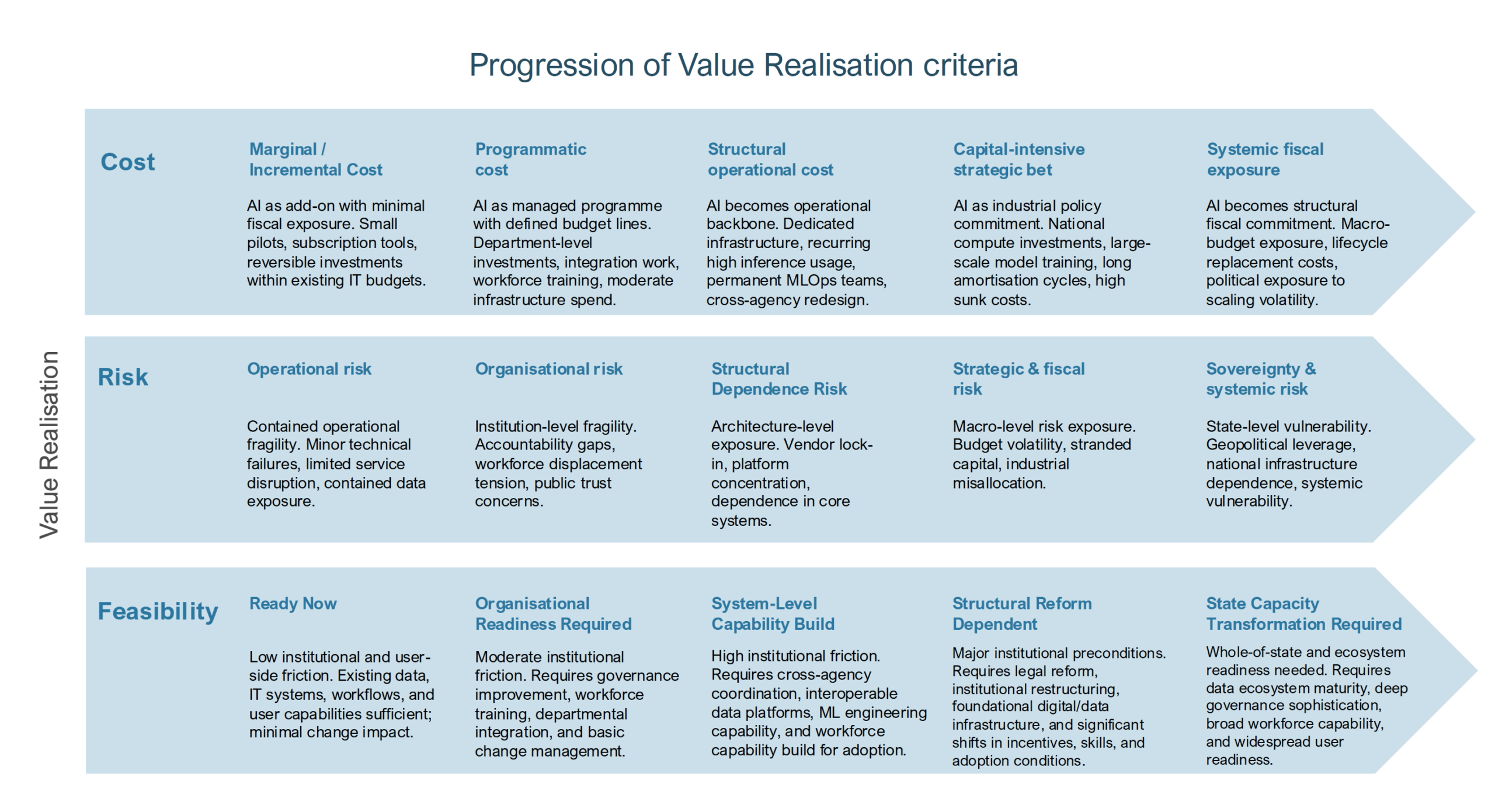
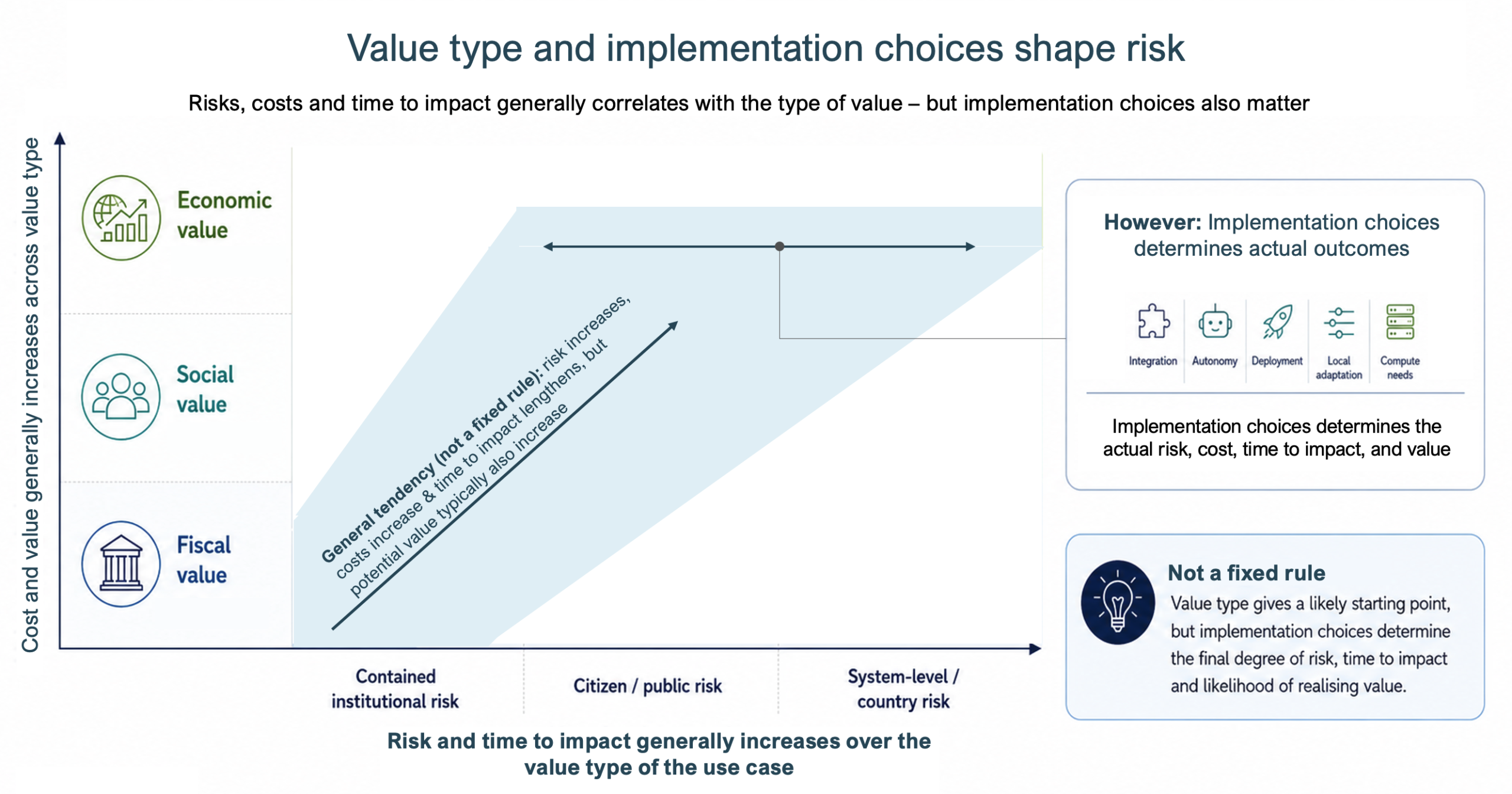
Risk is shaped by both the value being pursued and the way the AI is implemented. A use case focused on fiscal value may primarily expose government institutions to operational disruption, budget pressure, weak adoption or poor value for money. A use case affecting social outcomes, on the other hand, can expose citizens more directly to errors, exclusion or privacy harms, raising concerns around fairness, accountability and public trust. A use case with economy-wide applications may introduce broader market, strategic or sovereignty risks.
But these are tendencies, not fixed relationships. Implementation choices can materially change the risk of the same use case. Moving from an advisory tool to automated decision-making, embedding AI in core government systems, scaling it across institutions, or becoming dependent on dedicated infrastructure can all increase the consequences of failure. Assessing risk therefore requires looking at both what the AI is intended to achieve and how government chooses to implement it.
Practical application
To demonstrate how these value considerations and feasibility factors can inform decision-making in practice, it can be applied to the same set of illustrative AI use cases from our previous article, reflecting different levels of complexity, institutional readiness, value and feasibility.
-
Coding assistant for government teams
An AI coding assistant provides a useful example of a lower-complexity use case that can generate operational value with relatively modest implementation requirements.
In terms of value, the primary benefit is fiscal. By helping software developers write, test and document code more efficiently, a coding assistant can increase the output of existing teams and reduce the time required to deliver digital services. The resulting value is largely internal to government, taking the form of productivity gains, operational efficiency and potentially lower development costs.
Against this, implementation requirements are relatively modest. Costs are generally low and predictable, risks can be managed through existing governance processes and developers remain in control of decision-making.
The use case therefore scores high on feasibility and can often be deployed using existing infrastructure and capabilities. Overall, it represents a low-cost, low-risk opportunity that can be implemented immediately while delivering measurable operational value.
-
Automated grading of exam papers
Automated exam grading in schools illustrates a use case with the potential to create meaningful social value, while introducing greater implementation, governance and accountability considerations than a coding assistant.
The use case may reduce overtime costs, administrative pressure and marking backlogs, but is more likely to break even than generate major savings. Its stronger value lies in faster results, more consistent marking and improved productivity within education administration (i.e. a social benefit).
However, automated grading systems must align with local curricula and assessment standards, while ensuring fairness, transparency and appropriate human oversight. The principal risks relate to accuracy, bias, accountability and public trust. As a result, the use case is best suited to education systems with sufficient institutional capacity to monitor performance, manage exceptions and maintain confidence in the grading process.
-
Weather forecasting and multi-channel alerts
Weather forecasting and multi-channel alerts illustrate a higher-impact public-sector use case, with the potential to generate significant social and economic value at scale.
This use case may not generate major direct fiscal savings (in fact, it’s likely only an expense to start), but better forecasts and faster alerts can improve public safety, reduce exposure to shocks and strengthen resilience, especially for vulnerable communities and weather-sensitive sectors such as agriculture, logistics and disaster-risk management.
The use case involves moderate implementation costs and generally manageable risks, but its success depends on reliable data, effective dissemination channels and strong institutional coordination. Risks such as inaccurate forecasts, missed alerts or declining public trust must be carefully managed. While more demanding than the previous examples, the use case is feasible where governments have the operational capacity to translate weather information into timely and actionable public communication.
-
AI radiology triage in hospitals
AI radiology triage illustrates a high-impact public-sector use case with the potential to improve healthcare outcomes, particularly where specialist capacity is constrained.
In terms of value, the strongest benefits are social. By supporting faster diagnosis and prioritisation of cases, these systems can improve access to care, reduce delays and help make more effective use of scarce clinical expertise, particularly in hospitals in underserved areas.
However, this use case has relatively high risk and significant feasibility requirements. It requires robust validation, clear accountability, strong governance, clinician adoption and careful monitoring. As a result, the use case is best suited to health systems with sufficient technical, regulatory and institutional readiness to support safe and effective deployment.
-
A large language model fluent in local language
A local language large language model (LLM) illustrates a strategic, ecosystem-level investment that can enable a wide range of AI applications across government, business and society.
The strongest benefits of this use case are social and economic: improved access to digital services, reduced exclusion, better service navigation and new opportunities for firms and developers to build local-language products. If successful, it could support wider ecosystem expansion and help address structural barriers linked to language exclusion and low digital literacy.
Realising this value requires significant investment and long-term commitment. Developing and maintaining a local-language LLM involves challenges related to data availability, infrastructure, governance and ongoing technical support. It may also introduce strategic risks, including dependence on external technology platforms and long-term sustainability concerns. As a result, this is best viewed as a strategic enabling investment with the potential for transformative impact, rather than a near-term efficiency intervention.
Identifying the opportunities that matter most
The examples above illustrate that the best AI opportunities are not always those with the highest potential value. They are the opportunities where potential value is balanced against cost, risk and implementation feasibility.
Some use cases, such as coding assistants, can be deployed quickly and deliver immediate operational benefits. Others, such as local-language foundation models, may offer greater long-term social and economic value but require substantial investment, institutional capacity and strategic commitment. Both may be worthwhile, but they demand different expectations, sequencing and implementation approaches.
As governments face increasing pressure to adopt AI, the challenge is not simply deciding whether to invest in AI, but deciding where and how to invest. A structured assessment of value, cost, risk and feasibility can help decision-makers prioritise opportunities aligned with national priorities and capable of delivering meaningful impact.
To explore the full methodology, download here: Cenfri’s AI Value Framework
Originally developed in collaboration with the Ministry of ICT and Innovation in Rwanda as part of the Rwanda Economy Digitalisation (RED) Programme, the framework is designed for broader application across public institutions and private-sector organisations in emerging economies.