
Bridging supply and demand in Rwanda’s data skills market
Bridging supply and demand in Rwanda’s data skills market
25 May, 2026 •Rwanda’s ambitious digital transformation goals require a strong data skills ecosystem to support decision-making across government and private sector institutions. As the country works toward its Vision 2050 objectives, understanding the dynamics of data talent supply and demand becomes critical for strategic workforce planning.
In late 2024/early 2025 Cenfri, through the Rwanda Economy Digitalisation Programme, conducted a baseline study to understand the data skills market in the country. The study revealed a growing ecosystem of data professionals.
Since 2021, Rwanda’s data market has more than doubled in size, largely due to strong growth in the employment of data management professionals, particularly developers who make up the largest group. The market also includes a significant number of analysts and statisticians. This growth reflects increasing demand for specific, specialised skills.
A data market taxonomy
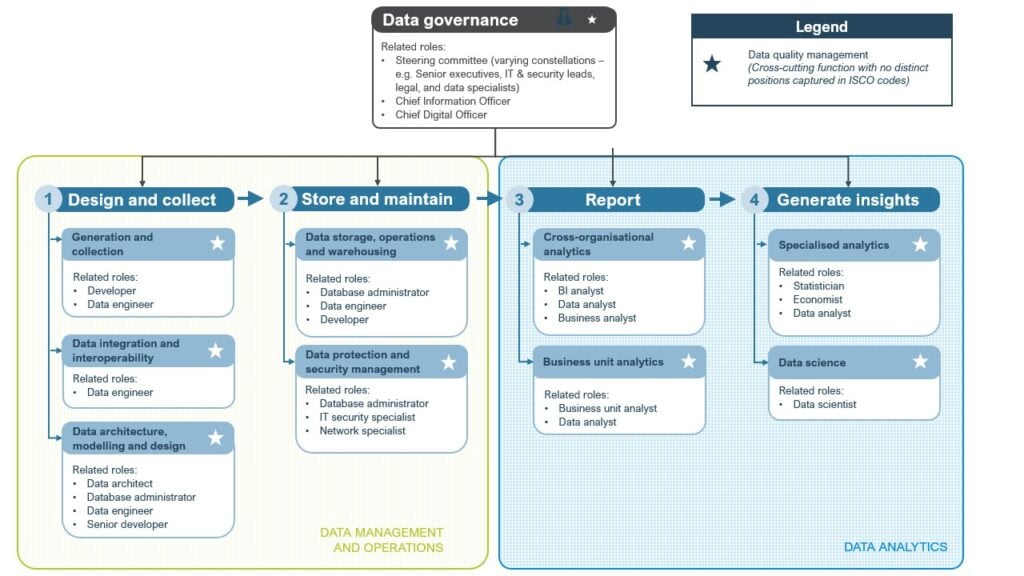
For the classification of data-related skills, Cenfri developed a data market taxonomy, which categorises data market functions and relevant job roles within institutions. There are two cross-cutting functions (data governance and data quality management), as well as two overarching roles categories, namely: a) data management and operations and b) data analytics. The two categories of skills are complementary as one unlocks value for the other.
The private sector dominates Rwanda’s data skills market, with employment more than double that of the public sector. This concentration is particularly pronounced in high-demand specialisations as:
- The majority of data engineers work in private sector organisations
- Most database administrators are employed by private companies
- Larger analytics teams are maintained by private sector entities
However, the public sector maintains an important advantage in data governance, employing more individuals in formal governance positions than private companies. This reflects government’s systematic approach to data management across ministries and agencies.
Government Digital Offices (DOs), which were established to move beyond basic IT infrastructure management in ministries and their affiliated agencies, remain heavily focused on digitalization functions. For example, 31% of DO positions fall outside the data market, although encouragingly, roles like data engineers and data scientists are now being created within ministries and agencies.
Demand for higher skilled specialists increasing
While academic institutions produce around 5 000 potentially relevant graduates annually (i.e. students in fields that tend to be the primary source of data-market skills rather than those studying pure data courses), unemployment rates among these qualified individuals remain high. At the same time, organisations report difficulties filling data roles, particularly for specialised positions.
This apparent contradiction stems from a fundamental skills mismatch. Employers prefer candidates with postgraduate qualifications, particularly from advanced programmes like those offered by Carnegie Mellon University, the African Institute of Mathematical Sciences, and the University of Rwanda’s African Centre of Excellence in Data Science. However, this preferred talent pool represents only 11% of available supply.
By 2030, the data market is projected to grow by more than 50%, adding approximately 7 500 new positions. It is likely these new positions will increasingly require specialised data and analytics talent.
Organisations are adapting through upskilling
Faced with skills shortages in specialised areas, organisations have developed internal talent development strategies involving existing employees.
Developers represent the largest pool available for upskilling. Their technical foundation makes them ideal candidates for transition into database administration and data engineering roles through intensive training programmes.
Analysts and statisticians provide a natural pathway into data science. These professionals already possess strong analytical thinking and mathematical foundations, requiring primarily technical upskilling rather than fundamental retraining.
This internal mobility has become critical for addressing shortages in “nascent but growing” roles, with organisations successfully transitioning existing staff to meet evolving demands.
Non-traditional pathways gaining recognition
A growing share of employees enters the data market through intensive training programmes at institutions like Rwanda Coding Academy, Andela Global, and ALX. These programmes produce graduates with practical skills and despite producing smaller cohorts than universities, they generate significant interest from employers due to their practical orientation and industry-readiness.
However, career progression for non-traditional entrants can be curtailed due to hiring policies where a degree is a prerequisite, particularly in the public sector.
How the increasing demand for talent could be addressed
Better matching supply and demand of skills across the whole data market will require coordinated intervention across multiple areas:
- Quality over quantity in education: Current unemployment rates among graduates indicate that simply producing more graduates will not solve skills shortages. Educational institutions must develop more industry-relevant curricula emphasising practical skills and real-world applications.
- Systematic upskilling programmes: Given the abundance of developers and analysts, targeted programmes could focus on transitioning these professionals into higher-demand roles through intensive technical training and clear career pathways.
- Sustainable funding models: Many high-quality programmes rely heavily on donor funding, raising sustainability concerns. Developing diversified funding through government support, industry partnerships, and revenue-generating activities could be essential.
- Recognition of non-traditional credentials: Broader acceptance by employers of alternative pathways, and focusing on skills rather than degrees, could help address immediate talent shortages while building more inclusive career opportunities.
Addressing the increased demand for specialised data talent could unlock capabilities in multiple sectors of the Rwandan economy, helping the country fulfil its digital and economic ambitions.
The baseline study was undertaken by Christiaan Loots, Nichola Beyers and Maja Pekkari.